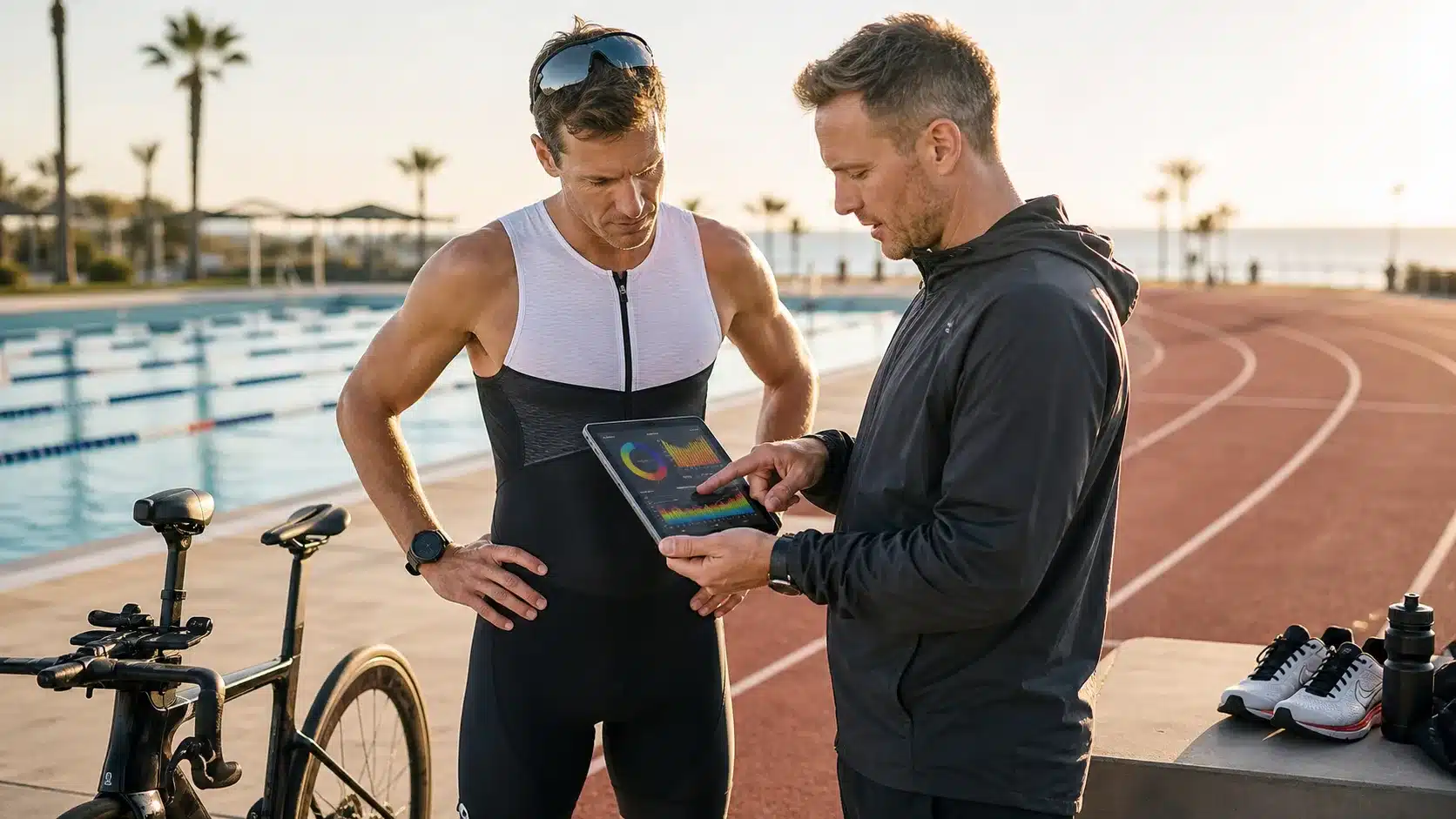
Two athletes can look similar, have similar endurance experience, follow the same triathlon plan and get very different results. That is not a failure of effort. It’s because your body, movement habits, recovery, experience and weekly schedule all affect how training lands.
We use the term “triathlon phenotype” to describe that practical mix. It’s a term that describes your aerobic and anaerobic capacity, threshold, muscle-fibre tendencies, economy, durability and fuelling needs. Understanding your phenotype – along with injury history and the real-life limits around work and family – helps us make each training hour count.
Make every training hour work harder for you
Your phenotype is not a fixed label, and it is certainly not a ceiling or an excuse. It is simply a useful starting point for spotting where you are most likely to improve.
A busy parent with strong cycling power and pure sprint potential but poor run durability needs a different focus from a naturally efficient runner who finds it hard to generate watts on the bike. Giving both athletes the same sessions may look tidy on paper, but it is rarely the smartest route to better racing.
Science-based triathlon training is not about obsessing over one smartwatch score or declaring yourself “a sprinter” for life. We get a clearer picture by bringing several clues together:
- Testing data such as your lactate or metabolic profile or power curve, based on heart rate, power, pace and lactate or breath-based response
- Your training response and TTE (time to exhaustion), repeatability (how well you repeat intervals within a session) or durability (how well you repeat hard sessions within a set period)
- Race history, technique and strength observations (or measurements) and injury niggles
- Nutrition habits, sleep, work demands and family commitments
This wider view helps us choose training, fuelling and race preparation that fits sprint, Olympic, 70.3 and Ironman goals.
Read the clues in your triathlon physiology
Think of it this way. Aerobic capacity is the maximum amount of oxygen your body can use during hard exercise to create energy. Threshold is the hardest effort you can hold steady for a significant period before fatigue begins rising much faster. Economy is the energy cost (oxygen and fuel) of moving at a given pace or power.
For example, two athletes may both run a 50-minute 10K. One might do it at a lower heart rate, with less strain and less carbohydrate use. The finish time is the same, but the path to that finish time is very different. Therefore, training these athletes to run a 45-minute 10K would likely look very different.
Performance testing can reveal useful patterns through lactate response, ventilation, muscle oxygen levels, cycling power, running pace, swim intervals, perceived effort and repeatability. Yet no single number should run the whole plan.
A test only matters if it answers a practical question: where are your biggest gains to be made? Should you build aerobic volume, improve threshold, develop top-end power or become better at holding form and pace when tired?
For a time-poor athlete, that clarity can stop wasted training hours. Strong aerobic fitness with a low bike threshold may point towards targeted bike intervals, rather than another easy run. If you fade late in races, we may look first at durability, pacing and fuelling before adding more intensity.
I often cite the example of an athlete who came to me unable to translate her excellent running into a good 70.3 run. Testing revealed that, while she was technically able to hold 180w for the bike of a Half Ironman, she was burning 120g of carbs per hour holding that 180w. Given that she was consuming around 60g carbs per hour on the bike, she was starting the run almost depleted. Testing revealed that she had a fuelling problem, not a running problem.
Match training to your biggest opportunity
Different athletes tend to respond well to different training emphases. An endurance-oriented athlete may be comfortable with steady aerobic work but they might already be operating close to their aerobic maximum. Therefore, they need carefully measured harder sessions to lift their VO2max. A power-oriented athlete may enjoy short intervals yet need a gradual build in long-course durability or carefully regulated intensity to decrease their glycolytic engine.
Muscle-fibre tendencies can influence what feels natural, but they do not decide what you can achieve. The aim is not to train only your strengths. It is to use your strengths while steadily addressing the limiter that matters most for your target event.
Race distance changes the job, too:
- Sprint and Olympic racing reward the ability to spend time at threshold, put out repeatable hard efforts, smash through sharp transitions and recover quickly.
- 70.3 racing asks for controlled pacing at that “comfortably uncomfortable” pace, solid aerobic strength and practiced carbohydrate intake.
- Ironman racing places greater weight on durability, discipline, comfort at race effort and ability to stay strong when fatigue arrives.
If you train three times a week, you do not need a watered-down professional plan. I work from the minimum effective dose: enough training stress to prompt adaptation, followed by enough recovery to benefit from it.
Improve technique where physiology cannot save energy
Technique is part of the overall picture because movement efficiency changes how much energy you spend at race pace. Fitness helps, but it cannot fully make up for movement that leaks energy.
In the pool, poor body position, an ineffective catch or rushed breathing can make a fit athlete work much harder than necessary. On the bike, an unstable position, unsuitable cadence habits or weak cornering skills can cost speed without building fitness. During the run, overstriding, excessive bounce or a collapsing posture can raise impact load and make late-race fatigue arrive sooner.
Generic cues are rarely enough. Not every swimmer needs the same drill, and not every runner needs to chase the same cadence. I like to use video, pace and heart-rate data, perceived effort, injury patterns, advanced IMU sensors, muscle oxygen sensors and coaching observations to find the movement change most likely to help you. The goal is not textbook-perfect form. It is economical, sustainable movement that holds together on race day.
Turn your data into a plan that fits real life
Understanding your phenotype is not about collecting more numbers for their own sake. It is about making better decisions and choosing the stress that produces the biggest adaptations in terms of metabolic economy, improving technique and efficiency where energy is wasted, and fuelling for the event ahead, all the while protecting recovery around a busy life.
If you’re not in the position to get some testing done, then review recent race results, training logs, heart-rate and power trends, swim-bike-run strengths, injury niggles and the point where performance usually fades. These will all provide clues that can show whether your biggest opportunity is aerobic development, threshold, durability, technical efficiency, pacing or nutrition.
The best programme is not the most complicated one, but the one built around the athlete, with enough science to be precise and enough flexibility to work day after day, week after week.
Turn your training data into meaningful progress
At TricoachMatt, we translate the numbers into practical decisions that fit around work, family and recovery. Our science-based triathlon training coaching helps you target the adaptations most likely to improve your next sprint, Olympic, 70.3 or Ironman. We will help you build confidence in every session, without treating your calendar like a laboratory experiment. Ready to discuss your goals? Contact us.